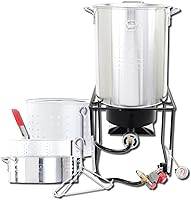
How Much Oil Does a Turkey Fryer Need?
The right turkey fryer oil amount covers your bird to the depth in the manual while staying within fill limits. Measure with water in the cold pot, remove the turkey and lifting equipment, then mark the remaining level before emptying and drying everything.
On this page (8 sections)
- How do you measure the turkey fryer oil amount?
- Does a 30 qt turkey fryer need 30 qt of oil?
- Which turkey fryer kit fits your cooking plans?
- How should you prepare the fryer and turkey?
- What oil should you buy, and can you reuse it?
- Which mistakes cause oil overflow?
- Does a seafood boil need the same oil amount?
- How should you choose your fryer and final oil amount?
The right turkey fryer oil amount covers your bird to the depth in the manual while staying within the fryer's fill limits. Measure it with water before heating anything, using the exact turkey and lifting equipment you'll cook with.
A 30 qt pot does not need 30 qt of oil. Its capacity includes space that the turkey will occupy, plus room needed as the oil rises and bubbles.
Buying a fryer first? Our guide to deep fryers and turkey fryers explains which type fits your food, space, and cooking plans.
How do you measure the turkey fryer oil amount?
Use water displacement in a cold pot, following the fryer's instructions. The water left after removing the turkey and lifting equipment marks your starting oil level.
- Place the cold pot on a stable, level surface with the burner off.
- Put the fully thawed turkey in the required rack or basket and lower it into the pot.
- Add water to the coverage depth in the manual without exceeding its applicable fill limits.
- Remove the turkey and equipment, allowing water to drain back into the pot.
- Mark or record the remaining water level using the manual's method.
- Empty the pot and thoroughly dry it, the turkey, and all equipment.
- Add oil to the measured starting level, staying within the fryer's limits.
Measure again when the bird or lifting setup changes. A mark from last Thanksgiving may be wrong for a different turkey.
Keep raw turkey refrigerated while you finish setup. Wash surfaces and tools that touch the bird or measuring water.
Can you estimate turkey fryer oil amounts by weight?
Turkey weight alone isn't enough to set the oil amount. Two birds of the same weight can fit differently, and a basket may displace a different volume than a rack.
Use the measurement to plan how much oil to have ready. If you need a volume in quarts, transfer the remaining water into a measuring container before discarding it.
Does a 30 qt turkey fryer need 30 qt of oil?
No, pot capacity is not the starting oil quantity. Pouring in the full capacity leaves no room for the turkey and can send oil over the rim.
Check what each fill mark means before using it. A maximum starting oil line and a maximum loaded liquid line serve different purposes.
If the bird and required coverage depth won't fit within the instructions, choose a smaller turkey or a larger compatible fryer. Don't solve a poor fit by leaving part of the bird above the required oil depth.
Our turkey fryer size guide explains why pot size and turkey fit need separate checks.
Which turkey fryer kit fits your cooking plans?
Choose one large pot for occasional turkey meals, or a set with a smaller pan if you'll also fry fish and other small batches. None of these kits removes the need to measure oil for your bird.
All 4 options below use outdoor propane burners. Skip them if you lack a suitable outdoor cooking area, and compare other setups in our guide to choosing a turkey fryer by fuel, size, and safety.
GasOne: Best for turkey and seafood
Choose GasOne for a single-pot setup that handles a holiday turkey and seafood boils. Its 30 qt aluminum stockpot comes with a perforated basket, turkey rack, thermometer, and marinade injector.
The regulator and hose assembly are included, so you can compare this as a coordinated kit rather than matching a pot to a separate burner. Follow its instructions for the correct rack or basket arrangement before measuring.
Skip it if small fish fries will be your main use. A set with a separate smaller pan gives you another vessel for those meals.
Feasto: Best for frequent outdoor hosts
Choose Feasto if you'll alternate between frying, boiling, and steaming for outdoor gatherings. It pairs a 30 qt pot with a 50,000 BTU burner, a square steel stand, and a lid hook.
Feasto specifies turkeys up to 20 lb, but the bird must still fit within the manual's coverage and fill limits. The included lifting hook and thermometer help with handling and oil monitoring.
Skip it if you mainly cook small batches. The large pot still needs cleaning, drying, and storage even when dinner is just a few fish fillets.
VEVOR: Best for mixed frying batches
Choose VEVOR if turkey is only part of your frying plans. Its 30 qt turkey pot and separate 10 qt fish fryer let you select a vessel suited to a large bird or smaller foods.
The kit includes a poultry rack, lifting hook, thermometer, and a burner with a maximum output of 54,000 BTU. Having 2 pots doesn't mean you can heat both at once on the included burner.
Skip this set if the extra pot will stay unused. Each vessel needs its own fill guidance, and the larger pot's measured oil mark won't transfer to the smaller one.
King Kooker: Best for regular fish fries
Choose King Kooker if you'll use a separate fish pan regularly. Its 29 qt turkey pot is paired with an 11 qt fry pan and basket.
The package includes a 33,000 BTU burner, turkey rack, lifting hook, thermometer, and regulator with a battery-operated timer. Read the timer instructions before cooking so you understand its operation.
Skip it if you want only a turkey pot. The second vessel adds storage needs, and burner output alone shouldn't decide your choice.
For a closer look at included parts, use our guide to turkey fryer kits.
How should you prepare the fryer and turkey?
Finish measuring, drying, and positioning before heating oil. Once the pot is hot, moving it or adjusting the setup becomes much more dangerous.
Set the burner outdoors on level, noncombustible ground, away from buildings, decks, and anything that can burn. Keep children and pets away, and never leave the fryer unattended.
Thaw the turkey fully, remove packaging and giblets, and check the cavity for ice. After measuring, pat the bird dry inside and out and dry the rack, basket, pot, and tools.
Follow our plain turkey fryer safety checklist for setup and handling. These propane kits don't belong in a garage or kitchen; see whether a turkey fryer can be used indoors for other fryer types.
What oil should you buy, and can you reuse it?
Choose a cooking oil suited to the manual's frying temperature and check its label for use limits. Consider food allergies before serving guests, especially if you're considering peanut oil.
Add oil to the cold, dry pot at the measured level. Monitor it with the thermometer, and follow the manual's heating directions rather than using burner power as a guide.
After cooking, let the oil cool completely before draining or moving the pot. Strain out food debris and store reusable oil in a clean, sealed container according to the oil maker's guidance.
Discard oil that smells rancid, foams persistently, or smokes at normal frying temperatures. Our guide to filtering and reusing deep fryer oil covers the next steps.
Wash the cooled pot and accessories as their instructions allow, then dry them fully before storage. Never pour used oil down a drain.
Which mistakes cause oil overflow?
Overfilling, trapped water, and lowering the turkey too quickly are key mistakes to avoid. A correct cold measurement helps control the starting volume, but careful handling still matters.
Don't use a frozen or partly frozen bird, reuse an old fill mark without measuring, or substitute lifting equipment after setting the level. Don't add extra oil once the turkey is in to make it look more covered.
Turn off the burner before slowly lowering the dried bird with the required equipment. Keep your face away from the opening, wear the protective gear in the manual, and relight only as directed once the bird is settled.
If oil spills, keep the burner off and don't move the hot fryer. If a fire starts, move away, call emergency services, and never use water.
Does a seafood boil need the same oil amount?
A seafood boil uses water or broth, not frying oil. Follow the cooker's boiling fill limits, including room for the basket and food.
Let the equipment cool completely before switching cooking methods. After boiling, wash and thoroughly dry everything before any later use with oil.
Read whether you can use a turkey fryer for fish or a seafood boil to match the vessel and accessories to the meal.
How should you choose your fryer and final oil amount?
Choose GasOne for turkey and seafood in one pot, or Feasto for outdoor meals where its lid hook and square stand fit your setup. Pick VEVOR for a smaller fish fryer, or King Kooker for its separate fry pan and timer-equipped regulator.
Set the turkey fryer oil amount by measuring your actual bird, regardless of the kit you choose. If safe coverage and fill limits conflict, change the bird or fryer before cooking.
Use the turkey fryer size guide to resolve fit questions, then review the safety checklist before lighting the burner.
Frequently asked questions
How much oil does a 30 qt turkey fryer need?
A 30 qt turkey fryer needs less than its full pot capacity in oil; the exact amount depends on the bird, lifting equipment, and required coverage depth. Measure with water according to the manual, then check the remaining level against the starting oil limit before emptying and drying everything.
How do you measure oil for a turkey fryer?
Measure with water while the pot is cold and the burner is off; put in the thawed turkey and required rack or basket, then add water to the manual's coverage depth. Remove the bird and equipment, let them drain, and mark the remaining level before emptying and drying everything.
Can you use too much oil in a turkey fryer?
Yes, excess oil can overflow when the turkey goes in and ignite if it reaches the burner; use the measured starting amount within the fryer's limits. Turn off the burner before slowly lowering the fully thawed, thoroughly dried bird, and keep it off if any oil spills.
Should the turkey be thawed before frying?
Yes, fully thaw and thoroughly dry the turkey before frying; ice and trapped water can cause hot oil to splatter or overflow, so check the cavity as well as the outside. Keep the bird refrigerated during setup and follow both the turkey preparation directions and your fryer's instructions.