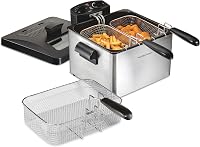
T-fal vs Cuisinart Deep Fryer: Which Is Better? (November 2026)
In the T-fal vs Cuisinart deep fryer comparison, choose T-fal for odor control and cooking checks, or Cuisinart for draining cooled oil through a pouring spout. Match food capacity and counter space to your usual meals before choosing.
On this page (11 sections)
- T-fal vs Cuisinart deep fryer: what changes your buying decision?
- Who should buy the T-fal, and who should skip it?
- Who should buy the Cuisinart, and who should skip it?
- Which fryer fits your usual meal size?
- Which shape fits your counter and storage space?
- How much should odor filtration influence your choice?
- How should you set up either fryer before the first batch?
- How do you get better results from either fryer?
- Which fryer makes cleanup easier?
- What mistakes should you avoid before and after buying?
- Which T-fal vs Cuisinart deep fryer choice should you make?
In this T-fal vs Cuisinart deep fryer comparison, choose T-fal for odor control and cooking checks, or Cuisinart for its oil container with a pouring spout. Your best choice depends on what you want to make easier each time you fry.
T-fal suits cooks who want to watch food through a closed lid and use a built-in timer. Cuisinart suits cooks who plan to drain cooled oil regularly and want a spout to help direct the pour.
Neither tank size nor wattage settles the choice. Think through the whole job: where you'll cook, how many batches dinner needs and where the cooled oil will go afterward.


T-fal vs Cuisinart deep fryer: what changes your buying decision?
Choose by cooking habits and cleanup, then check capacity and fit. These fryers offer different conveniences, even though both use 1,800-watt heating elements.
T-fal puts more emphasis on managing the cooking process. Its odor filter, viewing window and closed-lid basket lowering suit a kitchen where smells and splashes are concerns.
Cuisinart's clearest advantage is its removable enamel-coated oil container with a pouring spout. That feature matters when transferring cooled oil into a suitable storage or disposal container is a regular part of cleanup.
Both receive the same score because they suit different buyers. There is no single winner for every kitchen.
T-fal vs Cuisinart deep fryer: which features will you use?
Give priority to features that solve a recurring task. A timer helps you track a batch, while a pouring spout helps after cooking is over.
If you already use a kitchen timer, a built-in one may add little. If pouring oil from a wide container feels awkward, the spout may have more value during every cleanup.
Likewise, a viewing window is useful when you want to check browning without opening the lid. It still cannot tell you whether thick chicken or fish has reached a safe internal temperature.
Who should buy the T-fal, and who should skip it?
Buy T-fal if cooking smells and monitoring food are your main concerns. Its controls and lid features suit cooks who want to watch each batch without repeatedly lifting the lid.
The variable temperature control lets you set the heat for different recipes. Its adjustable digital timer runs up to 30 minutes and sounds an alert, which helps when you're preparing sides nearby.
Treat that alert as a reminder to check the food. Stay close while frying, and don't assume the timer turns off the heat.
The extra-large anti-fog window supports visual checks, while the closed-lid lowering system is designed to limit splashes as the basket enters the oil. Lower food carefully even with the lid in place.
Skip T-fal if filter care is a chore you'll avoid or if its deeper shape won't fit your cooking space. Buying odor filtration makes little sense if you won't follow the filter maintenance directions.
It also isn't an automatic choice for a small kitchen. Measure the appliance and the working space around it before deciding that a narrower body will fit better.
Who should buy the Cuisinart, and who should skip it?
Buy Cuisinart if handling cooled oil is the part of frying you most want to simplify. The container lifts out, and its spout helps direct oil into another vessel.
That suits someone who plans a full frying session, lets everything cool and then clears the counter. Set up the receiving container before lifting the oil tank so you aren't searching for one while carrying it.
Cuisinart uses an immersion-style heating element and says it supports fast heat-up and recovery. Equal wattage doesn't tell us which of these two fryers heats faster, so don't choose it on that assumption.
The stainless steel basket has a cool-touch handle. Cuisinart also backs this fryer with a limited 3-year warranty; keep the purchase record and read the terms for coverage.
Skip Cuisinart if odor reduction is your main reason for buying. T-fal has a specific feature aimed at that need.
Also skip it if you're choosing the larger oil tank because you expect a larger food load. The capacity numbers don't support that choice.
Which fryer fits your usual meal size?
T-fal has the higher stated food limit, while Cuisinart holds more oil. Those are separate measurements, and the difference matters when planning dinner.
T-fal holds 3.5 L of oil and up to 2.6 lb of food. Cuisinart holds 4 qt, about 3.8 L, of oil and up to 2.3 lb of food.
Use those food limits as ceilings, rather than targets for every recipe. Bulky onion rings, battered fish and loose fries take up basket space differently.
For 2 people cooking one fried side, either may fit the meal without using the maximum load. For a family serving fish and fries together, plan the batch order before deciding that either fryer is large enough.
A useful approach is to write down your usual menu and portions. Count how many separate loads it will take, including foods that need different temperatures or cooking times.
If keeping everyone supplied with hot food requires too many rounds, look beyond this pair. Our guide to choosing a home deep fryer explains how capacity fits into the wider buying decision.
Which shape fits your counter and storage space?
T-fal is narrower and lower, while Cuisinart is shallower. Neither has the smaller footprint in every direction.
T-fal measures 17.44 in deep, 9.25 in wide and 10.53 in high. Cuisinart measures 16.5 in deep, 11 in wide and 12.25 in high.
Mark those rectangles on the counter with paper before buying. Then allow the clearance required by the manual, room to lift the basket and a heat-safe place to set it down.
Check the storage location too. A fryer that fits on a shelf may still be awkward to lift out if the shelf is high or the opening is tight.
The sink and dishwasher matter as well as the counter. Removable parts are easier to deal with when you have space to drain, wash and dry them without balancing them over other dishes.
If both bodies feel too large for your kitchen, compare small deep fryers before committing. A smaller appliance can be a better match when you usually cook modest portions.
How much should odor filtration influence your choice?
Make odor filtration a deciding feature if frying smells limit how often you cook. T-fal says its system reduces cooking odors by up to 74%, but you should still use suitable kitchen ventilation.
Keep the area around the fryer clear so air can move as directed in the manual. A filter doesn't make it sensible to fry in a closed room with poor ventilation.
Filter care belongs in your buying decision. Read the maintenance directions before your first use so you know which parts need washing and whether any filter material needs replacement.
Also separate odor control from oil care. An odor filter addresses cooking smells; straining used oil removes loose food particles.
Our guide to whether oil filtration is worth it on a deep fryer explains that difference. Don't assume this T-fal model automatically filters used oil into a storage container.
How should you set up either fryer before the first batch?
Start with a stable work area, dry parts and the correct oil level. Read the manual before assembling the fryer, then wash the approved removable parts and dry them fully.
Set the fryer on a level, heat-safe counter away from the edge and from water. Keep the cord where nobody can snag it, and use the electrical connection required by the manual.
Both appliances draw substantial power, so check the instructions before sharing a circuit with another high-draw appliance. Don't improvise with extension cords or power strips.
Fill according to the fryer's minimum and maximum marks. Adding food displaces oil, so filling above the limit can create an overflow even before vigorous bubbling begins.
Prepare your food and serving area before heating the oil. Have a draining rack or suitable tray ready, along with the tools you need to lift and serve food safely.
Keep children and pets away from the cooking area. Our deep fryer safety checklist covers reminders for setup, hot oil and cleanup.
How do you get better results from either fryer?
Use manageable batches and let the oil return to the recipe's temperature between loads. Crowding the basket can cause a sharp temperature drop and uneven cooking.
Dry fresh ingredients well before adding them to oil. For frozen foods, follow the package and fryer directions, and remove loose surface ice where instructed.
Lower the basket slowly and watch the bubbling. If food clumps together, use only the method and tools allowed by the manual to separate it.
Plan foods by cooking temperature and flavor. Strongly flavored foods can affect oil you hope to reuse for something mild, such as donuts.
For coated foods, shake off loose flour or crumbs before frying. That reduces debris left in the oil, though wet batters may need a different loading method specified by the recipe and manual.
Check doneness rather than relying on color alone. Use a suitable food thermometer for foods such as poultry, following the recipe and food-safety guidance.
Drain finished food on a rack or suitable tray and season as the recipe directs. If several batches make up dinner, plan a safe warm-holding method so the first batch isn't cold before the last one finishes.
Which fryer makes cleanup easier?
Cuisinart helps with pouring cooled oil, while both offer dishwasher-safe removable parts. The better fit depends on which cleanup step you find awkward.
Cuisinart's basket, oil container and lid are dishwasher safe. Use gentle tools on the enamel-coated container and follow its care directions rather than scraping away stuck crumbs with metal utensils.
T-fal includes a removable, dishwasher-safe oil tank, lid, basket, aluminum filter, charcoal filter cover and excess-oil tray. Follow the manual for the washing method and placement of each component.
For either model, unplug the appliance and let the oil cool fully before draining. Leave it in a secure place during cooling rather than moving the filled fryer to clear the counter.
If the oil is suitable for reuse, strain it into a clean, dry, food-safe container. Label it so you can track what you cooked in it and avoid mixing strongly flavored oil with oil meant for milder foods.
Our guide to filtering and reusing deep fryer oil explains that routine. Discard oil that has developed an unpleasant smell, persistent foaming or other signs of breakdown.
Never pour used oil down the sink. Keep the electrical parts out of water, and dry all washed parts fully before reassembly.
For deeper cleaning, use our guide to cleaning a deep fryer alongside the model's manual. A cleaning method suitable for one fryer may not suit every component of another.
What mistakes should you avoid before and after buying?
Don't buy for the maximum capacity and then cook every batch at that limit. Leave room for food to move, and adjust the load to the recipe rather than forcing dinner into fewer rounds.
Don't confuse a cool-touch handle with a cool basket. Hot metal, steam and dripping oil still need careful handling.
Avoid lifting the lid with your face or hands over the steam path. Open it only as directed, and keep a clear landing space for the basket.
Don't add fresh oil as a substitute for cleaning out crumbs and checking the condition of used oil. Loose food left behind can burn during later batches.
Finally, don't put the fryer away before it is clean and dry. Planning storage and oil handling before buying is more useful than discovering afterward that you lack room for either task.
Which T-fal vs Cuisinart deep fryer choice should you make?
Choose T-fal if smells and watching food are your daily concerns; choose Cuisinart if draining cooled oil is the task you want to improve. Make that choice only after confirming the appliance fits your counter and your meal needs.
For T-fal, be ready to maintain the filter components. For Cuisinart, make sure the wider, taller body fits where you plan to cook and store it.
If you want another direct comparison before deciding, read Hamilton Beach vs Cuisinart deep fryer. Our best deep fryer guide is the next step if this T-fal vs Cuisinart deep fryer choice leaves you needing a different size or feature.
Frequently asked questions
Which is better, T-fal or Cuisinart deep fryer?
Choose T-fal if cooking odors, watching food through a window and a built-in timer drive your decision; choose Cuisinart if draining cooled oil through a pouring spout matters more. For family meals, compare food capacity and the number of batches you expect to cook, rather than choosing by tank size alone.
Does the Cuisinart deep fryer hold more oil than the T-fal?
Yes, Cuisinart holds 4 qt, about 3.8 L, while T-fal holds 3.5 L; the food limits run the other way: Cuisinart holds up to 2.3 lb and T-fal up to 2.6 lb. Follow food-specific batch guidance because bulky or wet foods may need smaller loads.
Does the T-fal deep fryer reduce cooking odors?
T-fal says its odor filtration system reduces cooking odors by up to 74%; keep using kitchen ventilation and follow the manual for filter care, since frying can still leave a smell. Odor filtration also serves a different purpose from straining crumbs out of used cooking oil.
Can you clean the Cuisinart deep fryer oil container?
Yes, Cuisinart's removable enamel-coated oil container is dishwasher safe, along with its basket and lid. Unplug the fryer and let the oil cool fully before draining it through the spout; follow the manual for washing, then dry the parts completely before putting the fryer back together.
Are these deep fryers the same wattage?
Yes, both fryers use 1,800-watt heating elements; that figure alone cannot rank their heat-up speed or how quickly the oil recovers after adding food. Batch size, food temperature and moisture affect cooking too, so choose by the features and capacity that fit your meals.